Injectable Biomaterial Scaffolds for Post–Prostate Cancer Tissue Regeneration: Current Strategies and Future Directions
Ozieme A.D. *
Department of Biomedical Engineering, University of Ibadan, Nigeria.
Adeleye A. A.
Department of Biomedical Engineering, University of Ibadan, Nigeria.
Ajide O. O.
Department of Mechanical Engineering, University of Ibadan, Nigeria.
*Author to whom correspondence should be addressed.
Abstract
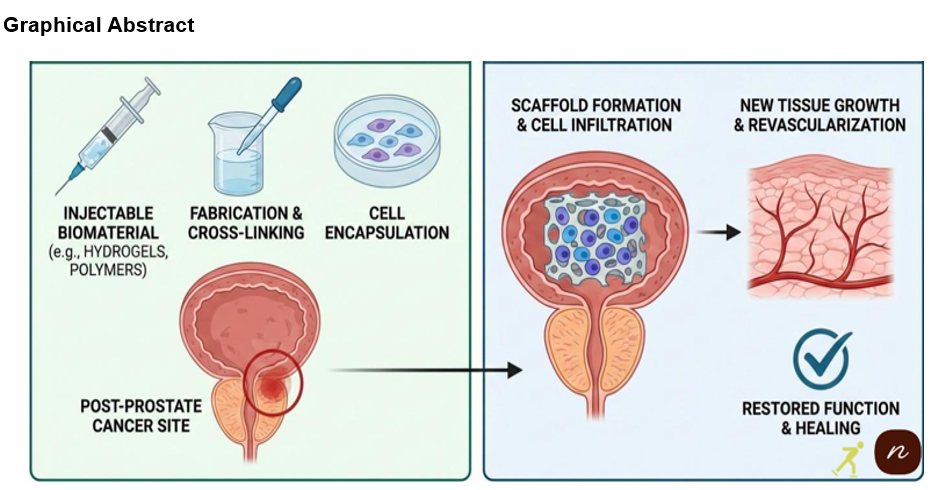
Prostate cancer treatments, particularly radical prostatectomy and radiotherapy, frequently result in extensive tissue loss, fibrosis, vascular injury, and functional complications such as urinary incontinence and erectile dysfunction. Current therapeutic options rarely achieve meaningful structural or functional regeneration, highlighting the need for advanced regenerative strategies. Injectable scaffolds have emerged as minimally invasive biomaterials capable of reconstructing extracellular matrix architecture, guiding stromal and epithelial repair, promoting angiogenesis, and attenuating fibrotic responses. Their regenerative mechanisms include providing a three-dimensional framework for cell adhesion and proliferation, enabling localized delivery of bioactive molecules, modulating inflammatory reactions, and supporting tissue remodeling processes. The incorporation of growth factors such as vascular endothelial growth factor (VEGF), fibroblast growth factor (FGF), platelet-derived growth factor (PDGF), and transforming growth factor-beta (TGF-β) further enhances vascularization, epithelial repair, and stromal integration. This review outlines recent progress in injectable scaffold systems for post–prostate cancer tissue regeneration, encompassing natural biomaterials including chitosan, collagen, hyaluronic acid, alginate, and gelatin, alongside synthetic platforms such as PEG, PLGA, PCL, self-assembling peptides, and thermo-responsive hydrogels. Emerging bioactive approaches, including nanocomposites, cell-laden constructs, exosome-enriched hydrogels, and smart materials responsive to biochemical or mechanical cues, are also discussed. In addition, fabrication strategies, delivery routes, preclinical evaluation methods, and key translational challenges are examined. Injectable scaffold platforms demonstrate significant potential to restore prostate stromal architecture, regenerate neurovascular bundles, and re-establish glandular function. However, optimization of biocompatibility, biodegradation, safety, regulatory considerations, and cancer recurrence risk remains essential to facilitate successful clinical translation in post–prostate cancer regenerative therapy.
Keywords: Injectable scaffold, Prostate cancer, tissue regeneration, biomaterials, hydrogel